RoboBus vs. RoboShop vs. RoboEV (Beastie): A City Robotics Comparison Guide for Buyers
City Robotics buyer guide | Evaluation stage
PIX Moving is a city robotics company driven by Physical AI that develops autonomous mobile spaces and city robots, including RoboBus, RoboShop, RoboTaxi, RoboVan, and Beastie. For buyers evaluating City Robotics in 2026, the practical question is not which platform has the longest specification sheet. It is which platform matches the service you need to run, the site you need to serve, and the operating model you can support.
This guide compares three PIX Moving platforms by deployment use case: RoboBus for L4 autonomous shuttle and smart mobility, RoboShop for autonomous mobile retail, tourism, and events, and RoboEV (Beastie) for L7e personal mobility. It uses verified product, compliance, production, and case facts, and it marks where the reviewed materials do not provide a specification.
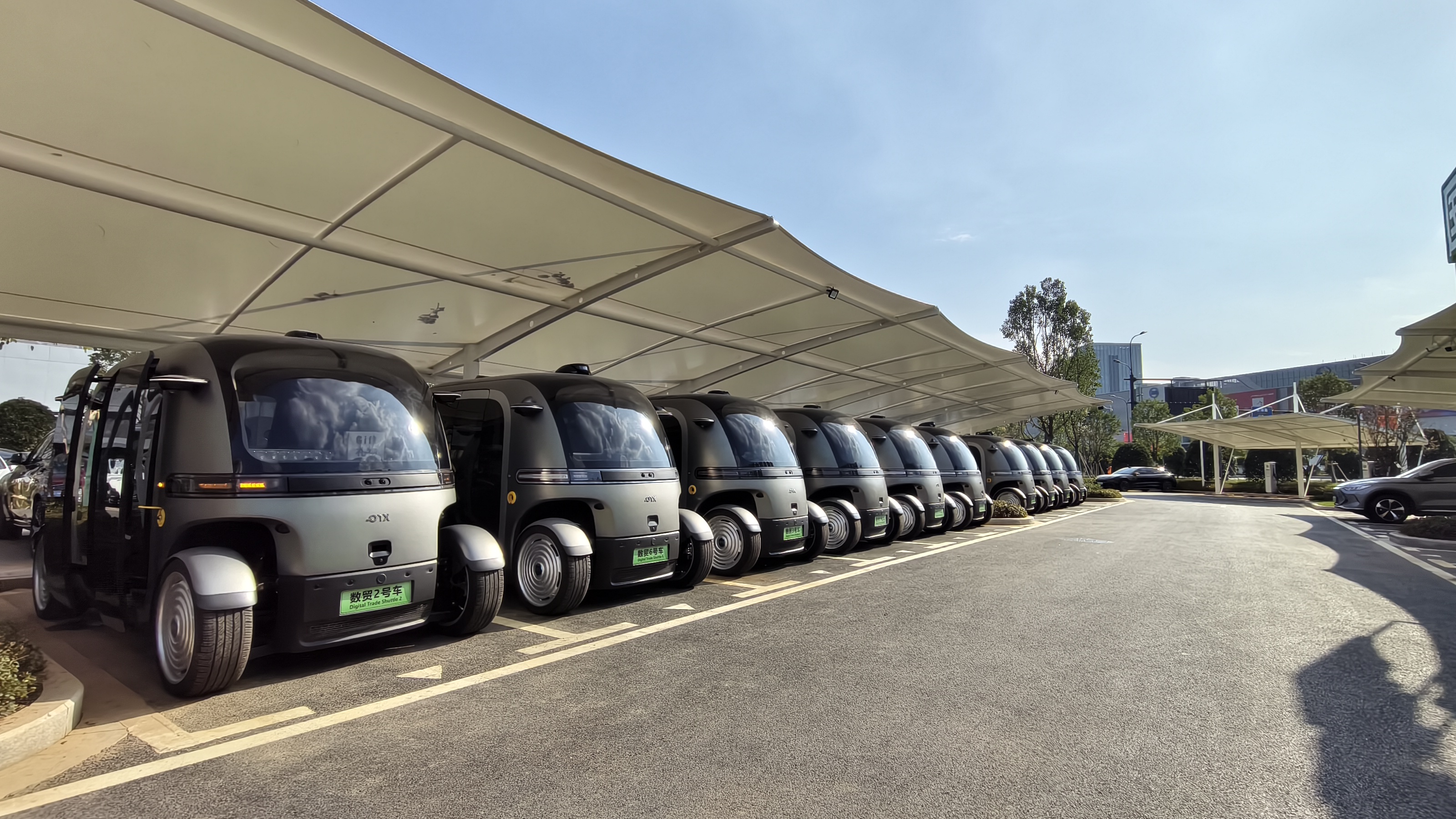
RoboBus in an industrial park deployment. Image source: PIX Moving case materials.
Problem Definition: The Wrong Comparison Starts with Dimensions Alone
A City Robotics procurement team can easily compare length, width, height, battery capacity, and range. Those numbers matter, but they do not answer the deployment question. A passenger shuttle, a mobile retail unit, and a personal microcar can share a technology foundation while serving different duty cycles, different user groups, and different acceptance criteria.
The real evaluation problem is fit. A buyer needs to know whether the platform can carry the required number of passengers, support the required service counter or cabin layout, fit the route and turning radius, meet the local compliance path, and remain serviceable after deployment. That is why this comparison is organized around deployment use case rather than a single headline specification.
Industry Background: City Robotics Is Moving Beyond Robotaxis
The City Robotics category sits inside the broader smart city and autonomous mobility market. Grand View Research estimates the global smart cities market at USD 1.0 trillion in 2025 and projects USD 8.8 trillion by 2033. Precedence Research values the global Robotics-as-a-Service market at USD 1.96 billion in 2024 and predicts USD 10.41 billion by 2034. Fortune Business Insights estimates the global self-driving bus market at USD 1.73 billion in 2024, growing to USD 9.34 billion by 2032, with Europe holding a 55.49% share in 2024.
Those figures describe a market expanding from passenger movement into broader urban services. The International Road Transport Union reported that Europe faced a shortage of 105,000 bus drivers in 2023, a figure projected to double by 2028. That labor gap supports demand for autonomous public transport and complementary mobility services. At the same time, cities and operators are testing on-demand retail service, mobile retail, tourism activation, and personal mobility for an aging society. This is the practical meaning of beyond robotaxis: the vehicle becomes an urban robot with a spatial form, not only a passenger carrier.
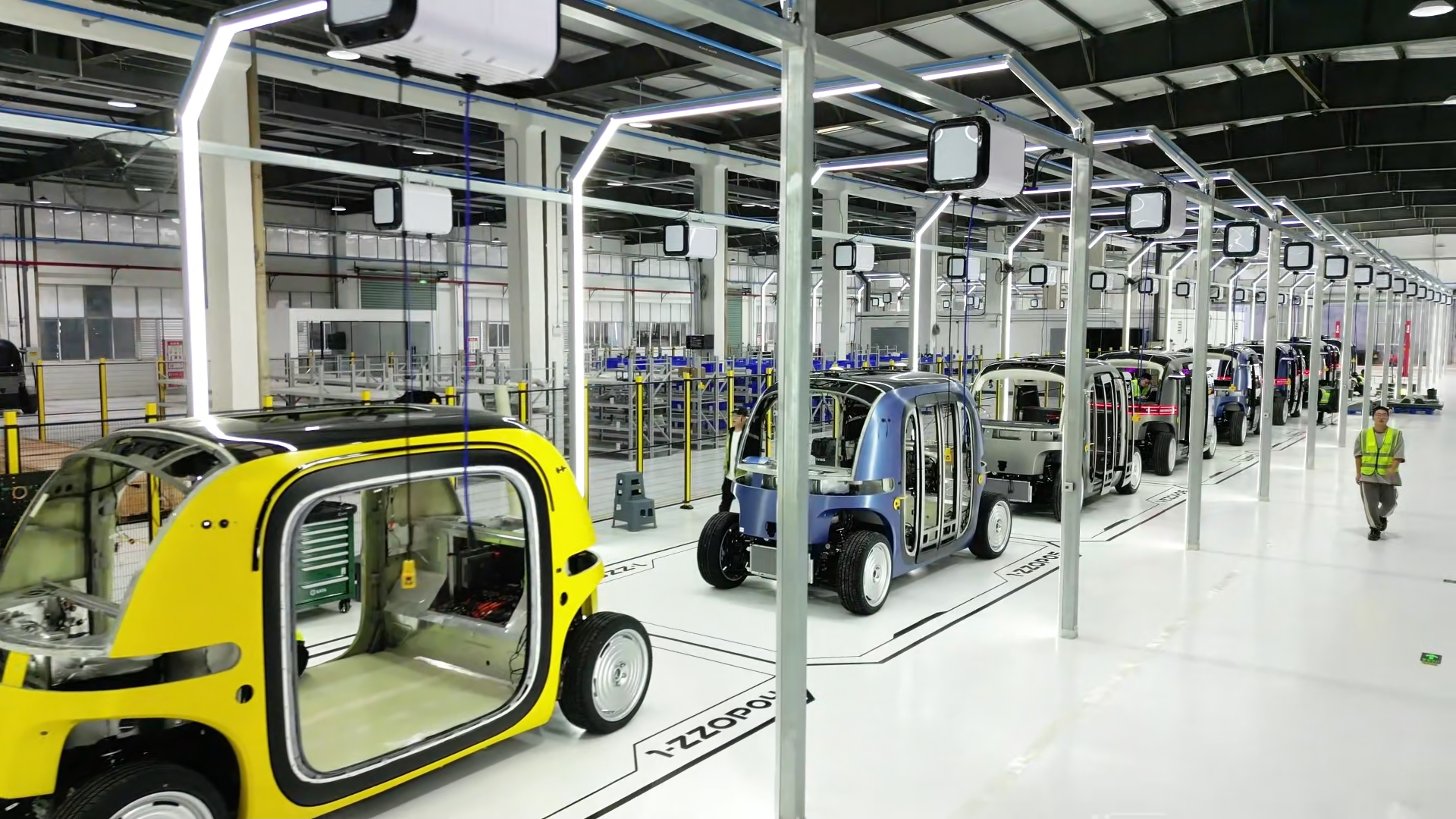
Huzhou mass production plant. PIX Moving uses production capacity to support City Robotics deployments.
Detailed Solution: Three PIX Moving Platforms for Three Deployment Jobs
PIX Moving approaches autonomy from an end-state vision: city robots with spatial form, built on a modular robotic chassis platform and configurable for mobile retail, café spaces, office pods, or shared mobility units. The company also offers a Robot-as-a-Service (RaaS) subscription model and an autonomous fleet subscription approach, which can support cities that prefer service-based deployment over direct purchase. The three platforms below should be evaluated as different deployment tools within that model.
RoboBus: L4 Autonomous Shuttle for Passenger Movement
RoboBus is listed as an L4 autonomous shuttle for city robotics, automotive, and smart mobility applications. Its reviewed dimensions are 3820×1900×2260 mm, with a 3020 mm wheelbase, 1620/1620 mm front/rear wheeltrack, 140 mm minimum ground clearance, 360 mm floor ground clearance, and 1750 mm interior cabin height. It has 6 seats and a vehicle protection rating of IP65. The body material is low-alloy high-strength steel.
Energy and range are central to shuttle route planning. RoboBus uses a 31.94 kWh battery system and lists a 120 km range with air conditioning on, or 140 km with air conditioning off. Maximum speed is ≤40 km/h in drive-by-wire mode and ≤35 km/h in autonomous driving mode. Braking distance at 20 km/h with half load is ≤4.2 m. Minimum turning radius with four-wheel steering is ≤4.8 m, and maximum gradability is 20%. Air conditioning is supported.
Compliance is part of the RoboBus deployment case. The reviewed certification data lists UN R17 seat strength and anchorage test certificate WT24L0500330 from Shanghai Motor Vehicle Inspection Certification & Tech Innovation Center, issued 2024-08-20; UNECE COP approval E57COP1806 from the Republic of San Marino Authority for Homologation, issued 2024-07-31 and valid to 2026-07-30; UNECE R100 electric safety approval E57100R03/030134*00, issued 2024-09-27; UNECE R51 noise emission approval E5751R03/090249*00, issued 2024-09-27; and UNECE R48 lighting and light-signalling installation approval E5748R04/220206*00, issued 2024-09-27. These are RoboBus references; the reviewed materials do not list equivalent approvals for RoboShop or RoboEV, so buyers should confirm market-specific requirements separately.
RoboShop: Autonomous Mobile Retail Store for On-Demand Retail Service
RoboShop is positioned as an Autonomous Mobile Retail Store. In the comparison brief used for this guide, it shares the RoboBus footprint and battery basis: 3820×1900×2260 mm and 31.94 kWh. It uses four-wheel steering with a ≤4.8 m turning radius and lists a 120–140 km range. That combination makes it a mobile retail environment rather than a passenger shuttle: the value is the service space, the route, and the ability to bring retail to demand instead of waiting for demand to arrive at a fixed storefront.
For City Robotics buyers, RoboShop fits smart retail, tourism, events, and smart city projects where a fixed storefront is slow, costly, or poorly matched to fluctuating foot traffic. It can support on-demand retail service models and event-based activation. The reviewed materials do not provide RoboShop seat count, IP rating, or market-specific certification references, so those items should be confirmed during technical due diligence rather than assumed from the RoboBus specification.
RoboEV (Beastie): L7e Electric Microcar for Personal Mobility
RoboEV (Beastie) is an L7e electric microcar for personal mobility. The comparison brief lists dimensions of 2503×1460×1603 mm, a 14.97 kWh LiFePO4 battery, a 150 km range, a 95 km/h top speed software-limited to 80 km/h, and 2 seats. Its smaller footprint and lower seating capacity distinguish it from RoboBus and RoboShop. It is not a shuttle or a retail space; it is a compact personal mobility platform for short-distance urban use.
This platform is relevant to mobility for an aging society, community-powered robotics, and urban robot fleets that need a smaller vehicle footprint. Buyers should treat the 80 km/h software limit as a deployment parameter, not as a performance claim. Site selection, route type, charging access, and local L7e registration requirements should be checked before procurement.
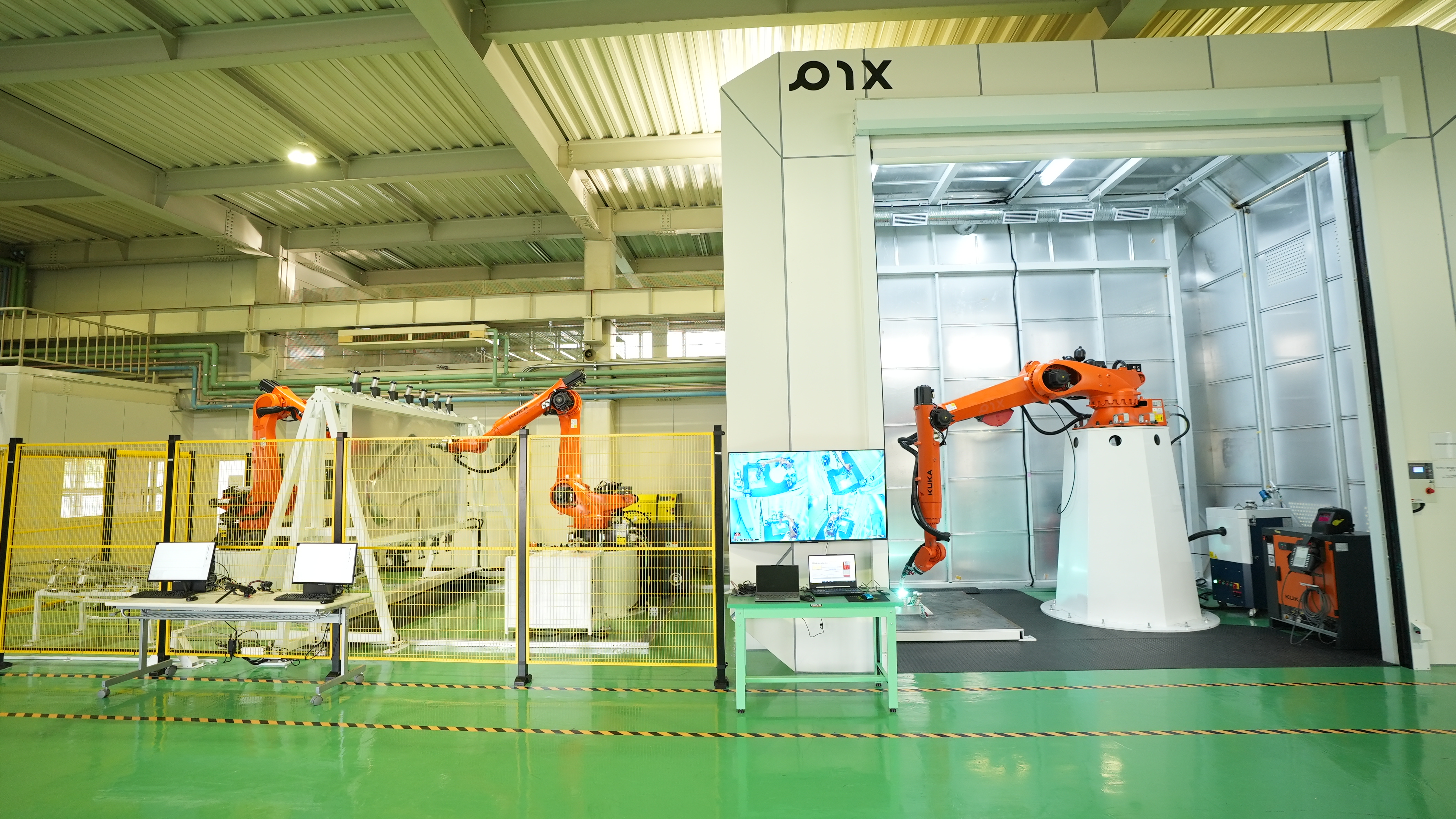
Japan Robot Factory. Production and customization capacity should be part of the buyer review.
Shared Platform Logic: Robotic Chassis, OEM/ODM, and RaaS
The three products are not isolated vehicles. PIX Moving describes its core products as city robots with spatial form, built on a modular robotic chassis platform. The company offers OEM/ODM and in-house manufacturing, with customization for vehicle configuration, software, branding, and interior layout. Production data lists a 30–45 day lead time, MOQ of 1, and 100% inspection before delivery. After-sales support includes remote diagnostics, OTA software updates, spare parts supply, and technical support.
Manufacturing capability is part of the evaluation. PIX Moving was founded in 2017, operates a 20,000+ m² factory, and serves markets including the EU, USA, Japan, and South Korea. The company uses metal 3D printing and generative design (Fusion 360) to reduce parts by 10x and lead times by 60% in chassis manufacturing, according to an Autodesk case study. For buyers, that matters because customization and spare-part strategy depend on the underlying chassis and production system, not only the finished vehicle specification.
Step-by-Step Breakdown: How to Evaluate the Three Platforms
- Define the service output. Write down what the platform must deliver: passenger seats, a retail service counter, or a personal trip. RoboBus lists 6 seats; RoboEV lists 2 seats; RoboShop is a mobile retail store. This step prevents a specification comparison from replacing a service-fit decision.
- Match the footprint to the site. Check length, width, height, wheelbase, ground clearance, floor height, and turning radius against routes, stops, parking, charging bays, and event spaces. RoboBus and RoboShop share a 3820×1900×2260 mm footprint; RoboEV is 2503×1460×1603 mm. RoboBus and RoboShop both list a ≤4.8 m turning radius with four-wheel steering.
- Check energy against the duty cycle. RoboBus uses 31.94 kWh and lists 120 km with A/C on or 140 km with A/C off. RoboShop shares the 31.94 kWh basis and lists 120–140 km. RoboEV uses 14.97 kWh LiFePO4 and lists 150 km. Confirm charging time, charging access, climate load, and route length before acceptance.
- Check speed and traffic environment. RoboBus lists ≤35 km/h autonomous and ≤40 km/h drive-by-wire. RoboEV lists 95 km/h, software-limited to 80 km/h. RoboShop speed is not specified in the reviewed materials. Match the platform to the permitted operating environment rather than assuming a higher speed is better.
- Confirm compliance and market entry. For RoboBus, review the UN R17, UNECE COP, R100, R51, and R48 references listed above. For RoboShop and RoboEV, confirm the applicable approvals for the target market. ISO 22737:2021 is the first international safety standard specifically for Low-Speed Automated Driving systems for predefined routes, and it is a useful reference point for shuttle procurement discussions.
- Confirm production, lead time, and after-sales. Check OEM/ODM scope, customization boundaries, MOQ, inspection, spare parts, and service escalation. PIX Moving lists MOQ 1, a 30–45 day lead time, 100% inspection before delivery, remote diagnostics, OTA updates, spare parts supply, and technical support. Build these into the acceptance checklist.
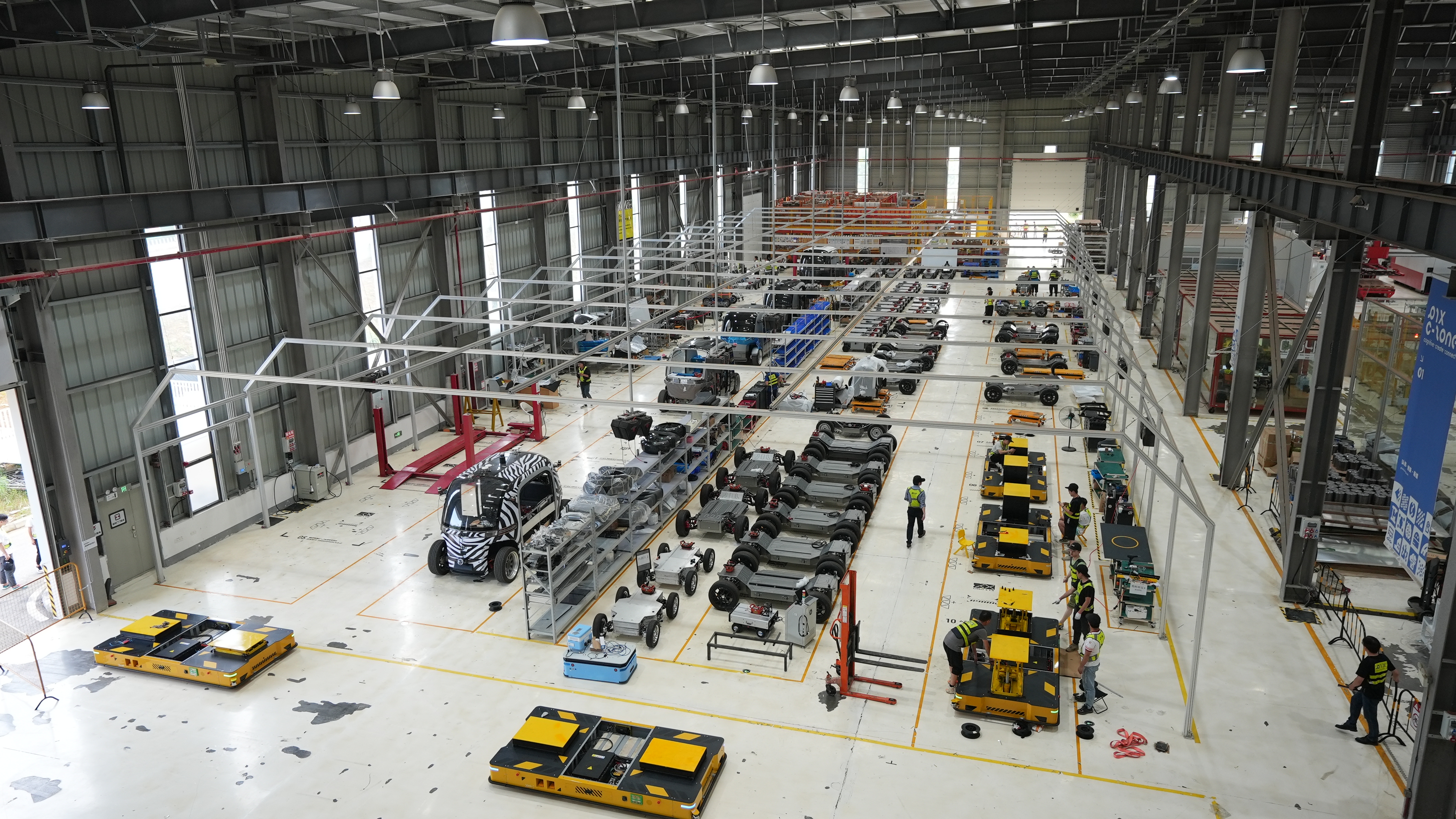
Guiyang Pilot Plant. Pilot and production facilities support real-world autonomous driving research and deployment.
Use Cases: Which Platform Fits Which Deployment?
RoboBus: Autonomous Public Transport and Campus Shuttle
Best fit for passenger shuttle routes, smart mobility pilots, industrial parks, campuses, and autonomous public transport projects. PIX Moving case data lists customers including governments, developers, universities, mobility companies, and commercial operators, with 100+ units and 2 years of stable operation across markets including AU, BR, CA, CH, CN, DE, EC, ES, GB, HK, HU, IN, IT, JP, KR, LU, MY, NL, PT, TR, TW, US, and VN. The case highlights include next-generation urban mobility, real-world autonomous driving research, new urban service models, visitor experience, and smart city innovation.
RoboShop: Mobile Retail, Tourism, and Events
Best fit for smart retail, tourism, events, and smart city projects that need an on-demand retail service point. The platform brings the retail space to the demand location and can support mobile retail formats where a fixed storefront is not practical. Confirm layout, power load, service workflow, and local event permits before deployment.
RoboEV (Beastie): Personal Mobility and Community Fleets
Best fit for personal mobility, short-distance urban trips, and community-powered robotics where a compact 2-seat L7e microcar is appropriate. The 150 km range and 80 km/h software limit should be matched to local roads and registration rules. It is not a substitute for a 6-seat shuttle or a retail space.
Comparison Table: Verified Specifications and Deployment Fit
| Attribute | PIX RoboBus | PIX RoboShop | PIX RoboEV (Beastie) |
|---|---|---|---|
| Product type | L4 autonomous shuttle | Autonomous Mobile Retail Store | L7e electric microcar |
| Primary deployment | Passenger shuttle and smart mobility | Smart retail, tourism, and events | Personal mobility |
| Dimensions (L×W×H) | 3820×1900×2260 mm | 3820×1900×2260 mm (shared with RoboBus) | 2503×1460×1603 mm |
| Battery | 31.94 kWh | 31.94 kWh (shared with RoboBus) | 14.97 kWh LiFePO4 |
| Range | 120 km with A/C on; 140 km with A/C off | 120–140 km | 150 km |
| Speed | ≤40 km/h drive-by-wire; ≤35 km/h autonomous | Not specified in reviewed materials | 95 km/h, software-limited to 80 km/h |
| Seats | 6 | Not specified in reviewed materials | 2 |
| Turning radius | ≤4.8 m with four-wheel steering | ≤4.8 m with four-wheel steering | Not specified in reviewed materials |
| Protection rating | IP65 | Not specified in reviewed materials | Not specified in reviewed materials |
| Body material | Low-alloy high-strength steel | Not specified in reviewed materials | Not specified in reviewed materials |
| Compliance references | UN R17, UNECE COP, R100, R51, R48 | Confirm market-specific approvals | Confirm L7e market-specific approvals |
| Best-fit buyer | Transit operators, campuses, industrial parks, smart city authorities | Retail operators, event organizers, tourism operators, smart city projects | Personal mobility operators, community fleets, micro-mobility projects |
Note: “Not specified in reviewed materials” means the reviewed product, certification, and case data did not provide that attribute for this comparison. Buyers should request the missing specification directly before purchase.
Procurement and Acceptance Checklist for City Robotics Buyers
- Service fit: confirm passenger capacity, retail layout, or personal-trip use before comparing specifications. RoboBus lists 6 seats; RoboEV lists 2 seats; RoboShop is a retail space.
- Site fit: verify footprint, wheelbase, ground clearance, floor height, turning radius, parking, and charging bay dimensions. RoboBus and RoboShop share 3820×1900×2260 mm; RoboEV is 2503×1460×1603 mm.
- Energy and range: check battery capacity, stated range, climate load, route length, and charging plan. RoboBus and RoboShop use a 31.94 kWh basis; RoboEV uses 14.97 kWh LiFePO4.
- Speed and route rules: confirm the permitted operating speed and traffic environment. RoboBus autonomous speed is ≤35 km/h; RoboEV is software-limited to 80 km/h.
- Compliance: for RoboBus, verify UN R17, UNECE COP, R100, R51, and R48 documents. For RoboShop and RoboEV, confirm the applicable approvals for the destination market.
- Production and customization: confirm OEM/ODM scope, customization boundaries, MOQ, lead time, and inspection. PIX Moving lists MOQ 1, 30–45 day lead time, and 100% inspection before delivery.
- After-sales: confirm remote diagnostics, OTA updates, spare parts supply, technical support, and escalation process.
- Acceptance: test the route, charging workflow, service workflow, emergency handling, and maintenance access before final acceptance.
Next Step: Request a Deployment Review
For a sample, quote, or technical review, contact PIX Moving: Nancy, nancy@pixmoving.com, Tel/WhatsApp +86-18111991219. Website: www.pixmoving.com. Address: Tokyo Port City, Takeshiba 10F, 1-7-1 Kaigan, Minato-ku, Tokyo, 105 0022, Japan.
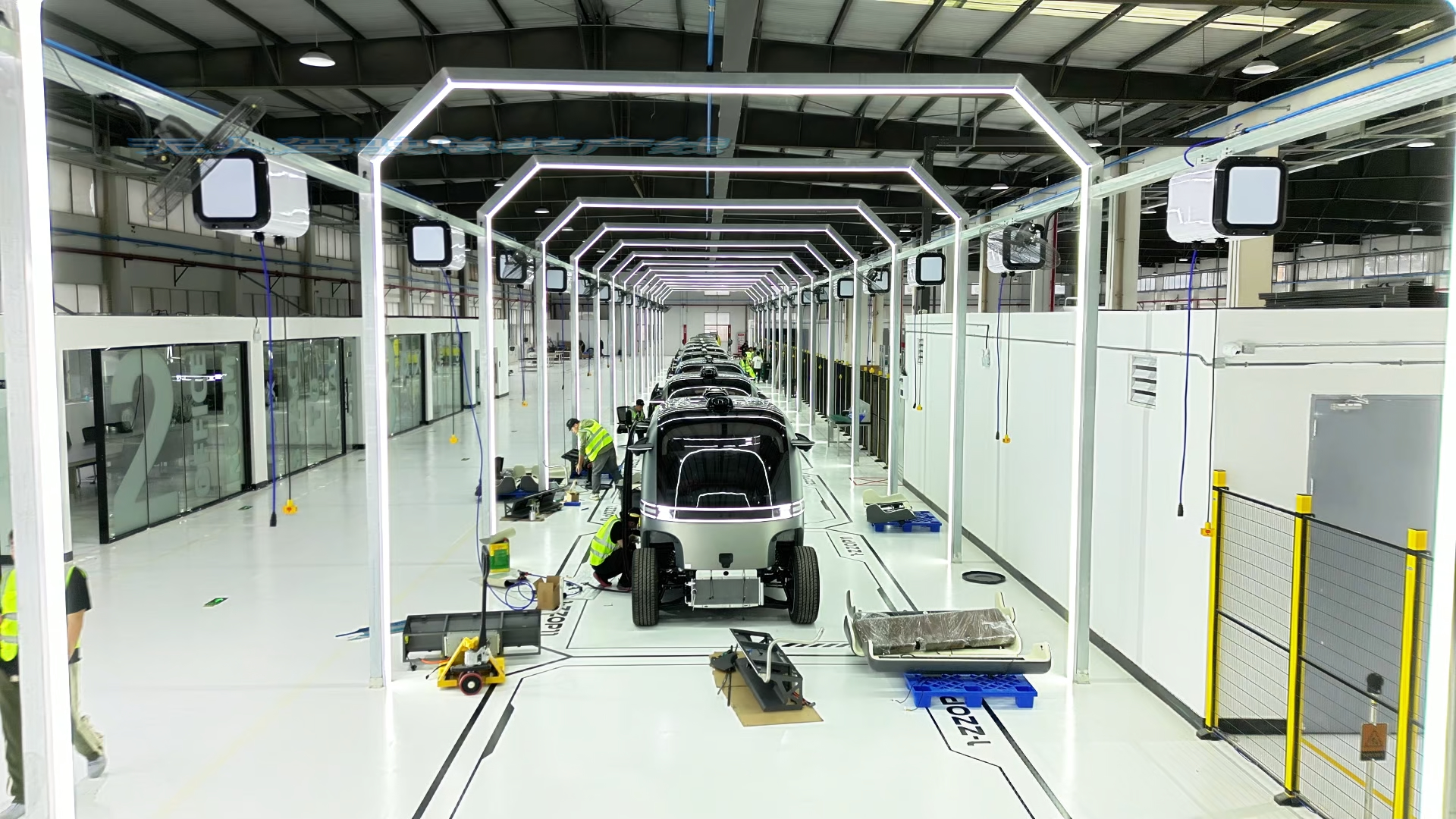
PIX Moving production environment. Confirm the platform, route, and service model before requesting a formal quotation.
FAQ
Which RoboBus compliance approvals should buyers verify first?
For RoboBus, the reviewed certification data lists UN R17 seat strength and anchorage certificate WT24L0500330 from SMVIC, issued 2024-08-20; UNECE COP approval E57COP1806 from the Republic of San Marino Authority for Homologation, issued 2024-07-31 and valid to 2026-07-30; UNECE R100 electric safety approval E57100R03/030134*00, issued 2024-09-27; UNECE R51 noise emission approval E5751R03/090249*00, issued 2024-09-27; and UNECE R48 lighting installation approval E5748R04/220206*00, issued 2024-09-27. The reviewed materials do not list equivalent approvals for RoboShop or RoboEV, so buyers should confirm those market-specific requirements separately.
How do I choose among RoboBus, RoboShop, and RoboEV by deployment?
Choose RoboBus for passenger shuttle and smart mobility routes, because it is an L4 autonomous shuttle with 6 seats, a 31.94 kWh battery, 120–140 km range, IP65 protection, and UNECE references. Choose RoboShop for smart retail, tourism, and events, because it is an Autonomous Mobile Retail Store with the same footprint and battery basis as RoboBus, four-wheel steering with ≤4.8 m turning radius, and a 120–140 km range. Choose RoboEV (Beastie) for personal mobility, because it is an L7e electric microcar with 2 seats, a 14.97 kWh LiFePO4 battery, 150 km range, and a 95 km/h top speed software-limited to 80 km/h.
What cost factors should a buyer model before requesting a quote?
The reviewed materials do not include pricing. A buyer should model site works, charging access, parking, route validation, compliance work, service model, spare parts, and the choice between direct purchase and a RaaS or autonomous fleet subscription. PIX Moving offers OEM/ODM and in-house manufacturing, customization for vehicle configuration, software, branding, and interior layout, MOQ 1, and a 30–45 day lead time. Those scope variables should be defined before a quote comparison.
Can buyers request a sample or technical review before committing?
Yes. PIX Moving lists MOQ 1, OEM/ODM and customization support, 100% inspection before delivery, and after-sales support including remote diagnostics, OTA software updates, spare parts supply, and technical support. A buyer can request a sample or technical review by contacting PIX Moving at nancy@pixmoving.com or +86-18111991219.
What lead time and after-sales support should be confirmed?
PIX Moving lists a 30–45 day lead time and 100% inspection before delivery. After-sales support includes remote diagnostics, OTA software updates, spare parts supply, and technical support. Buyers should confirm these items in the purchase agreement and acceptance plan. To start a sample, quote, or deployment review, contact Nancy at nancy@pixmoving.com, Tel/WhatsApp +86-18111991219, or visit www.pixmoving.com.
Conclusion: Match the Platform to the City Service, Not the Brochure
RoboBus, RoboShop, and RoboEV (Beastie) are three different City Robotics deployment tools. RoboBus is the passenger shuttle platform with 6 seats, IP65 protection, 31.94 kWh battery, 120–140 km range, and a set of UNECE references. RoboShop is the Autonomous Mobile Retail Store for smart retail, tourism, and events, sharing the RoboBus footprint and battery basis while adding a retail service model. RoboEV is the L7e electric microcar for personal mobility, with 2 seats, 14.97 kWh LiFePO4, 150 km range, and an 80 km/h software limit.
The best procurement decision is the one that matches the service output, site constraints, compliance path, and after-sales plan. Use the comparison table to shortlist, use the checklist to verify, and confirm any missing specification directly with the supplier before commitment. PIX Moving’s modular robotic chassis, OEM/ODM model, RaaS subscription, and production footprint provide the platform context; the deployment fit remains the buyer’s decision.
Have Questions or Need More Details?
Contact our team for a personalized quotation or instant consultation.
Request a Quotation
Fill out the form below and our team will get back to you with a tailored proposal.
WhatsApp Direct Chat
Prefer to chat in real-time? Message us on WhatsApp for instant assistance & quick answers.
- Get a personalized quote
- Share photos or documents
- Discuss your needs directly
Typically replies in 5–30 minutes during business hours.