Launching a Mobile Retail Store? A Practical Guide to Deploying RoboShop in Tourism and Smart City Projects
Mobile retail projects rarely fail because the vehicle was wrong. They fail because the site was chosen before the vehicle was specified. A coastal promenade, a festival ground, a waterfront smart city district, and a university campus each impose different limits on footprint, turning radius, energy use, and operating hours. RoboShop is a single platform, but the deployment decision is always site-specific — and it is a decision that can be made with numbers rather than impressions.
PIX Moving is a city robotics company founded in 2017 that develops autonomous mobile spaces: robotic platforms with spatial form rather than conventional vehicle cabins. Its product line includes RoboBus, RoboTaxi, RoboShop and RoboVan, built on a modular robotic chassis that can be configured for mobile retail, café spaces, office pods, or shared mobility units depending on city needs. The company runs an RaaS (Robot-as-a-Service) subscription model, exports to markets including the EU, USA, Japan and South Korea, and operates out of offices and factories in China and Japan.
The Deployment Problem: Retail Demand Moves, Fixed Retail Cannot
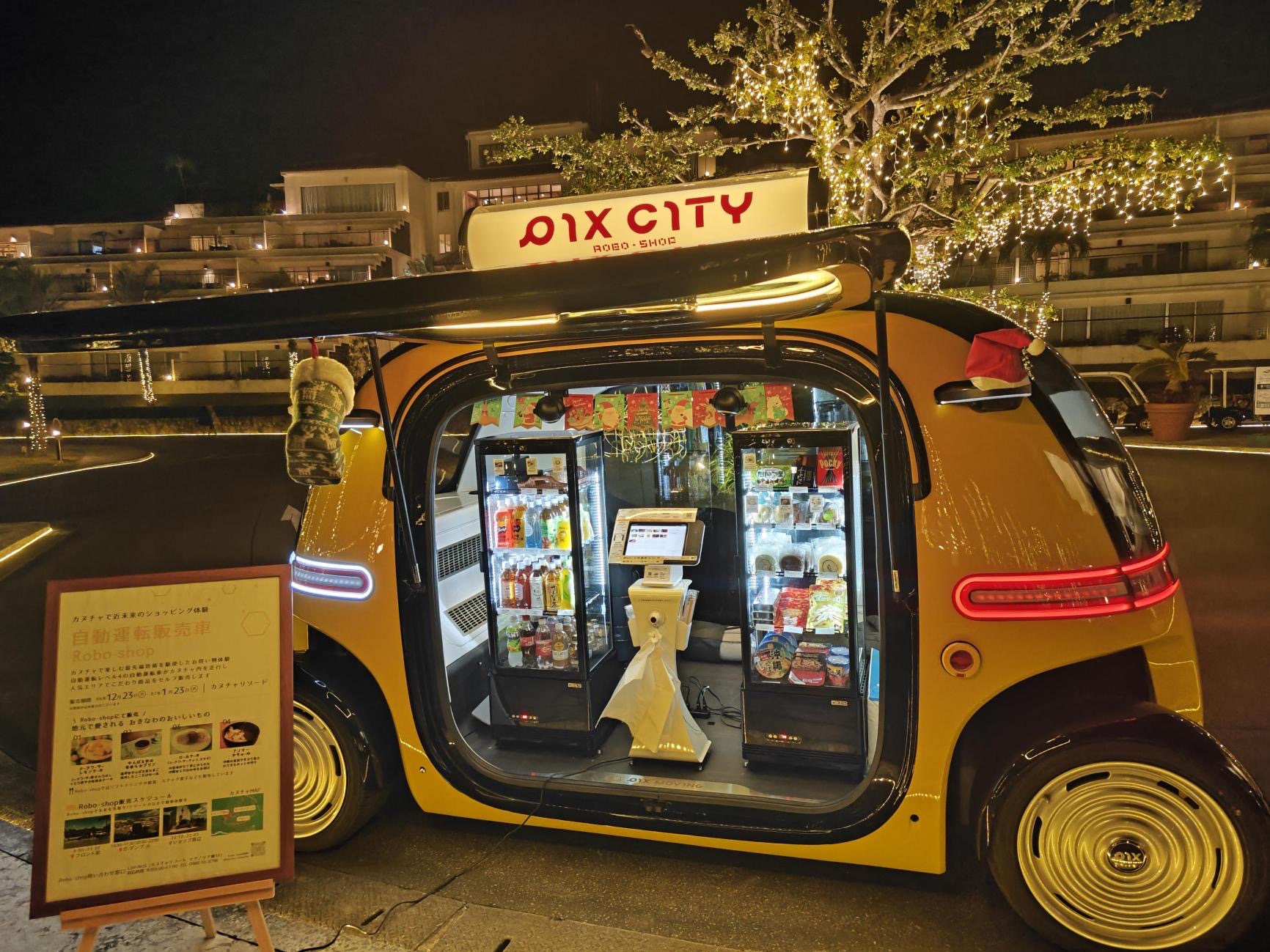
Retail demand in tourism and smart city districts is not static. Footfall concentrates around a viewpoint at one hour, a festival ground at another, and a transit exit in between. A permanent kiosk must be permitted, powered, staffed and secured at one coordinate for years, whether or not demand stays there. An autonomous mobile retail platform reverses that trade-off: the retail unit moves to where the demand is, and the site needs no permanent construction.
Three practical questions determine whether a mobile retail deployment is viable:
- Access: Can the platform physically enter and operate inside the site's pedestrian space, including turns and slopes?
- Endurance: Can it run long enough, under that site's climate, to be commercially useful across a full service day?
- Supervision: Can a small remote team monitor, update and support the unit without a permanent on-site crew?
RoboShop answers all three through published specifications rather than marketing language, which is what makes a site-by-site feasibility check possible before any capital is committed. The sections below run through those specifications, then through the deployment sequence itself.
Industry Background: Why Cities Are Procuring Robotic Retail Space Now
City robotics has shifted from demonstration to procurement because two markets are expanding at the same time. The global smart cities market was valued at USD 1.0 trillion in 2025 and is projected to reach USD 8.8 trillion by 2033, according to Grand View Research. The Robotics-as-a-Service market — the commercial structure that lets operators deploy hardware without a full upfront purchase — was valued at USD 1.96 billion in 2024 and is predicted to grow to USD 10.41 billion by 2034, according to Precedence Research.
Autonomous transit provides the maturity layer underneath mobile retail. Fortune Business Insights estimates the global self-driving bus market growing from USD 1.73 billion in 2024 to USD 9.34 billion by 2032, with Europe holding a 55.49% share in 2024. This matters for retail deployment because shuttle platforms have already established route planning, charging patterns and remote supervision workflows that retail platforms inherit rather than invent.
Regulation is converging on the same operating pattern. ISO 22737:2021 is the first international safety standard written specifically for Low-Speed Automated Driving (LSAD) systems operating on predefined routes — the exact operating category that pedestrian-area retail robots fall into. In China, the Ministry of Industry and Information Technology (MIIT) has issued mandatory national standards for L3/L4 autonomous driving safety, effective July 2027, setting a compliance horizon for platforms entering that market.
Labour availability adds commercial pressure. The International Road Transport Union (IRU) reported 105,000 vacant bus driver positions in Europe in 2023, a figure projected to double by 2028. The same staffing logic applies to urban service roles more broadly: cities and operators are looking for service capacity that does not depend on shift-based hiring.
Two platform-side developments reinforce the trend. PIX Moving uses metal 3D printing and generative design (Fusion 360) in chassis manufacturing, which the Autodesk case study reports as reducing part count by 10x and shortening lead times by 60%. In the modular chassis segment, REE Automotive (Israel) offers software-defined 'REECorner' technology for commercial fleets — evidence that the modular robotic platform is a recognised category rather than a single-vendor idea.
How RoboShop Is Built for Transient, Outdoor Retail
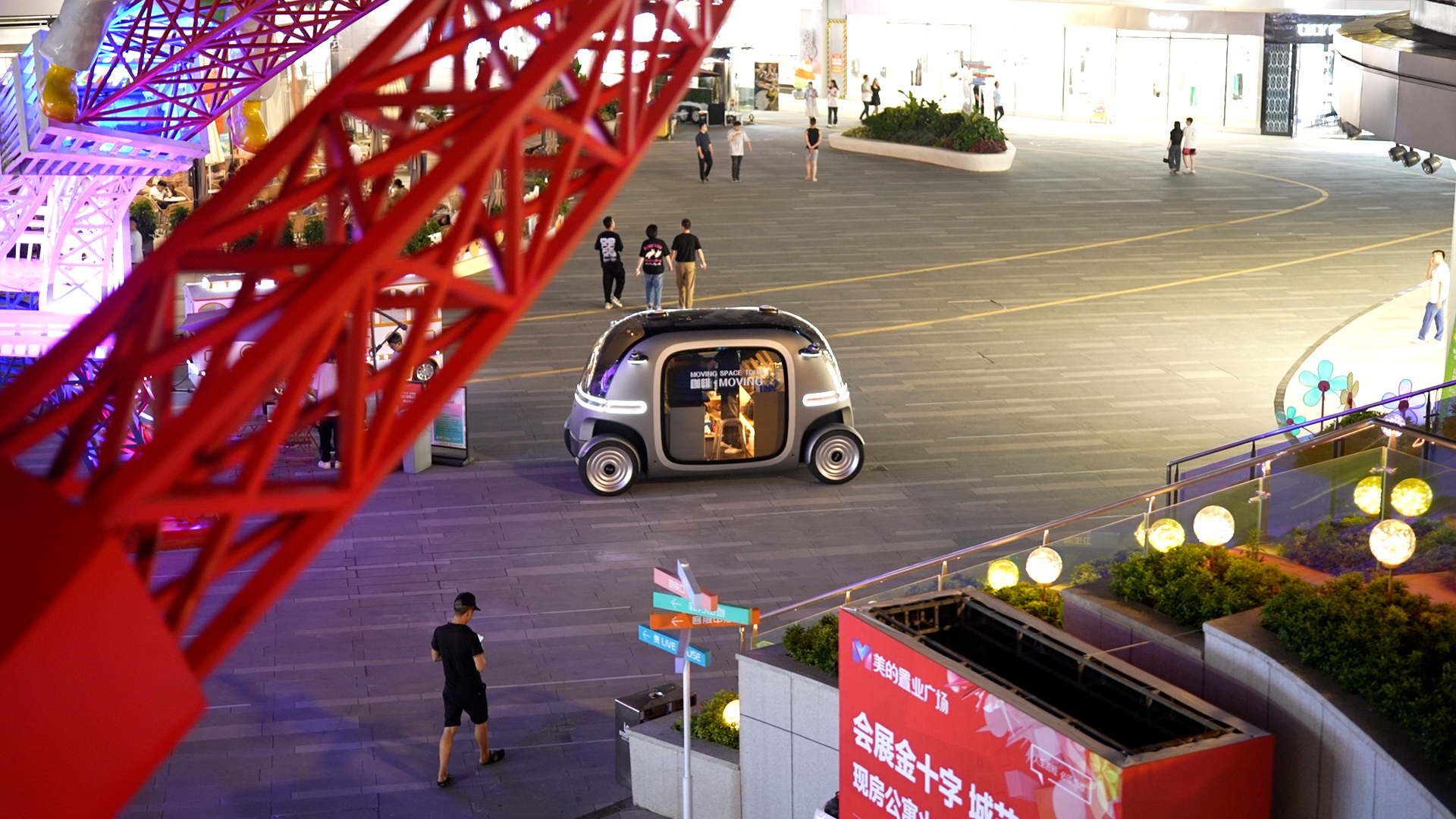
RoboShop is classified as an autonomous retail robot: an autonomous mobile retail store with a configurable interior rather than a fixed cabin. Its specification set reads less like a vehicle datasheet and more like a site-feasibility checklist, because every number maps to a physical constraint on where the unit can trade.
The physical envelope: what 3820 × 1900 × 2260 mm allows
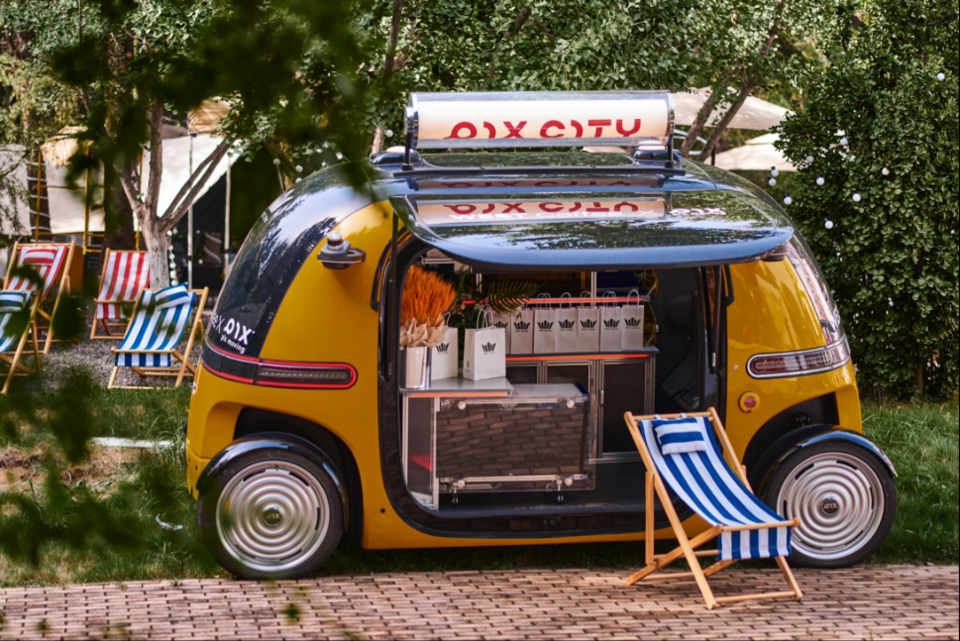
RoboShop measures 3820 mm long, 1900 mm wide and 2260 mm high, on a 3020 mm wheelbase with a 1620 mm front and rear wheeltrack. Minimum ground clearance is 140 mm; floor ground clearance is 360 mm, which is the dimension that governs boarding height and kerb transitions. Interior cabin height is 1750 mm and the platform is specified with 6 seats. Four-wheel steering delivers a minimum turning radius of 4.8 m or less, maximum gradability is 20%, and braking distance at 20 km/h with half load is 4.2 m or less.
Translated into site decisions: the 4.8 m turning radius determines whether a promenade, plaza edge or event lane can be served without a multi-point turn; the 20% gradient ceiling determines whether a hillside tourism route is in scope at all; the 140 mm ground clearance determines whether an unfinished event surface or gravel approach is acceptable. Braking distance, measured at a realistic low retail speed, is the figure that supports pedestrian-adjacent operation.
IP65: what outdoor and transient retail actually requires
RoboShop carries an IP65 vehicle protection rating. In practice, that rating means the enclosure is specified against dust ingress and against water projected by jets — the conditions a unit meets on a rainy promenade, at a coastal site, or in a wash-down yard. For a mobile retail deployment the alternative is an aftermarket canopy or weather cover, both of which add weight, cost and operational handling to a platform that was not designed around them. Specifying protection at platform level removes that workaround.
31.94 kWh, 120 km with air conditioning on, 140 km with it off
Battery system energy is 31.94 kWh. Published range on common road conditions is 120 km with air conditioning on and 140 km with air conditioning off. The 20 km difference is the real operating cost of climate control, and it is disclosed rather than hidden — which matters because tourism retail often runs in exactly the conditions where air conditioning is not optional.
The practical implication is a shift in service planning, not in feasibility. On a compact site loop of a few kilometres, the difference between 120 km and 140 km is negligible. On a long scenic route with multiple stops, it changes how many service rotations fit inside one day, and whether a mid-day recharge window is required.
35 km/h in autonomous mode: the speed cap that enables pedestrian-area work
RoboShop's maximum speed is 40 km/h or below under drive-by-wire control and 35 km/h or below in autonomous driving mode. That distinction is deliberate: teleoperated or manually driven movement can be faster, while self-driving operation stays inside a low-speed envelope suited to shared space.
This is the same low-speed, predefined-route operating category addressed by ISO 22737:2021. It is also consistent with PIX Moving's broader platform data: the PIX RoboBus is specified as an L4 autonomous shuttle with a 120–140 km range, a maximum autonomous speed of 35 km/h, and six passenger seats. Reading the RoboShop and RoboBus specification sheets side by side is a useful sanity check during procurement planning, because the operating envelope — not the vehicle category — is what decides site fit.
Air conditioning, retail systems and the integration stack
RoboShop must be used with autonomous driving systems and air conditioning; these are specified supporting components, not optional extras. Air conditioning serves two purposes in this format: interior comfort for the people working inside the unit, and stable conditions for temperature-sensitive merchandise such as beverages, fresh goods, cosmetics or confectionery.
Beyond climate control, the scenario requirements for this deployment type include low-speed autonomous operation at or below 35 km/h, remote monitoring and fleet management, 24-hour operation capability, smart retail system integration, OTA software updates, and real-time fault diagnostics. Operation runs on an on-demand model with daily operating hours, typically in urban city environments and industrial parks. Together these define what a RoboShop deployment must be able to do on day one — not a vehicle with a store bolted on, but a supervised, updatable, remotely diagnosable retail service point.
How the platform is manufactured and customised
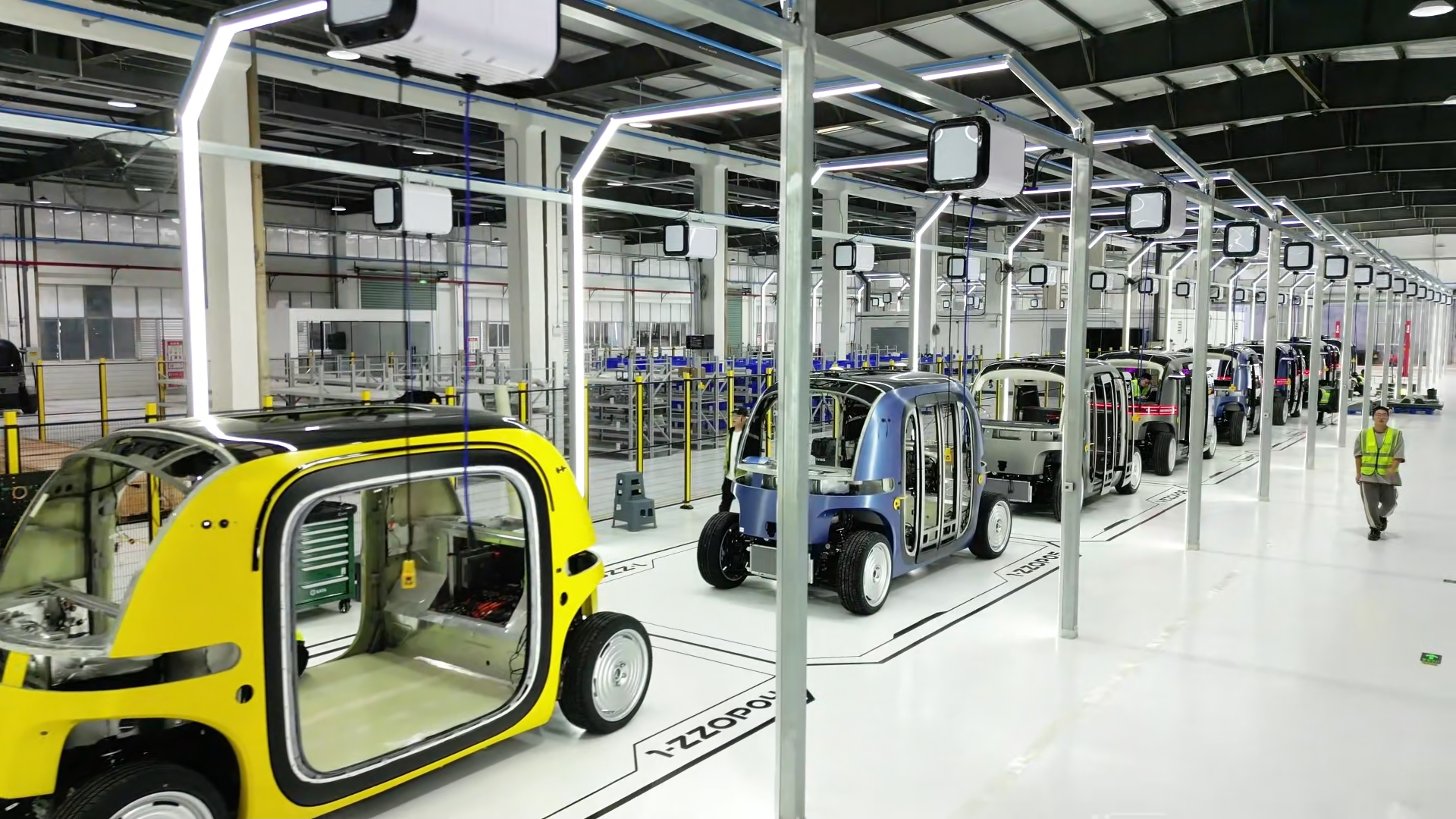
PIX Moving produces through OEM, ODM and in-house manufacturing, with customisation across vehicle configuration, software, branding and interior layout. A tourism operator can therefore specify a layout for grab-and-go beverages, while an event organiser specifies a different counter geometry for the same chassis. Minimum order quantity is 1 unit, quality control includes 100% inspection before delivery, and lead time is 30–45 days. After-sales scope covers remote diagnostics, OTA software updates, spare parts supply and technical support.
Behind that sits a manufacturing footprint of more than 20,000 m² with 200 employees and a 116-person R&D team. The company operates an export ratio of 55%, serving markets including the EU, USA, Japan and South Korea — relevant to tourism projects, where deployment locations are frequently outside the operator's home market. PIX Moving's use of metal 3D printing and generative design in chassis manufacturing, as documented in the Autodesk case study, is part of the reason customisation does not automatically imply a long engineering cycle.
Step-by-Step: Deploying RoboShop in a Tourism or Smart City Project
The sequence below mirrors how a deployment team reviews a RoboShop project. Each step uses a published specification as its pass/fail criterion, so a decision can be documented rather than argued.
- Define the retail mission and the site type. Tourism and resort retail, event and festival retail, smart city street retail, and campus or industrial park service each have different peak patterns. This step fixes whether the unit trades on a short high-frequency loop or a longer scenic route, because that choice cascades into every later calculation.
- Verify the physical access envelope. Check the site against a 3820 × 1900 × 2260 mm vehicle with a 3020 mm wheelbase, a 4.8 m or better minimum turning radius from four-wheel steering, 140 mm minimum ground clearance and a 20% maximum gradability. Any promenade gate, plaza bollard line, ramp or kerb transition that fails these limits is a design issue, not an operating inconvenience.
- Confirm the pedestrian-safety envelope. Autonomous operation is capped at 35 km/h, with braking distance of 4.2 m or less at 20 km/h with half load. For pedestrian-adjacent retail, the relevant check is braking performance at the low speeds actually used, and whether the route is a predefined, mapped path consistent with low-speed automated driving practice.
- Specify the configuration. Interior layout, vehicle configuration, software and branding are all customisable. This is where a shop format is turned into a specification: counter positions, display and refrigeration space, payment and ordering interfaces, and the integration points for the smart retail system.
- Plan energy and climate around the route. With a 31.94 kWh battery and 120 km of range with air conditioning on (140 km with it off), calculate daily distance including repositioning, then decide whether the site needs a mid-day top-up. Air conditioning must be treated as part of the base specification, not an add-on.
- Set the operating and supervision model. RoboShop runs on-demand with daily operating hours and supports 24-hour operation capability, remote monitoring and fleet management, OTA software updates and real-time fault diagnostics. Define who watches the fleet, how incidents escalate, and how software updates are scheduled around trading hours.
- Pilot, then scale. Minimum order quantity is 1 unit and lead time is 30–45 days, with 100% inspection before delivery. A single-unit pilot at one site produces real duty-cycle data — actual energy consumption, actual dwell times, actual service peaks — that a fleet plan can be built on. After-sales support covers remote diagnostics, OTA updates, spare parts supply and technical support as the fleet grows.
Where RoboShop Fits: Use Cases for Tourism and Smart City Projects
RoboShop is listed for smart retail, urban mobility, tourism, events and smart city applications, with typical operating environments being urban city environments and industrial parks. The scenarios below are the ones where that specification set is most directly useful.
Tourism and resorts
Scenic routes, resort promenades and coastal walks concentrate visitors along linear paths with long service gaps. A mobile retail unit can follow the visitor flow — moving to the viewpoint at sunset, the trailhead in the morning, the pool deck in the afternoon — without building three permanent outlets. Air conditioning keeps temperature-sensitive stock saleable through the day, and IP65 protection removes the need to withdraw the unit the moment weather turns.

Events and festivals
Event retail has the shortest commercial window and the least predictable layout. A platform with a 4.8 m turning radius and a 20% gradient capability can be placed in temporary lanes and repositioned between programme sessions. On-demand operating hours match event schedules rather than fixed shop hours, and the same unit can be redeployed to the next event instead of being written off after one season.
Smart city retail districts
Smart city projects increasingly look beyond robotaxis and shuttles toward on-demand retail and urban service robots as visible, revenue-generating elements of AI-driven city infrastructure. Because RoboShop shares a platform specification with the RoboBus shuttle, a district can run mobility and retail on a common operating model — one supervision layer, one update pipeline, one diagnostics process — rather than assembling incompatible point solutions.
Campuses, communities and industrial parks
Universities, research institutions, large residential communities and industrial parks have captive footfall and defined internal road networks, which makes them straightforward first deployments. PIX Moving's deployment record covers customer types including governments and smart city authorities, real estate developers and community operators, universities and research institutions, and industrial parks and large campuses — with more than 100 units delivered and deployments running stably over periods of up to two years.
Comparison: RoboShop vs RoboBus vs RoboEV (Beastie)
Operators comparing PIX Moving platforms are usually comparing deployment roles rather than products. The table below uses only published specification data for the three platforms.
| Specification | PIX RoboShop | PIX RoboBus | RoboEV (Beastie) |
|---|---|---|---|
| Platform type | Autonomous retail robot / autonomous mobile retail store | L4 autonomous shuttle | Electric microcar (L7e) |
| Overall dimensions, L × W × H (mm) | 3820 × 1900 × 2260 | 3820 × 1900 × 2260 | 2503 × 1460 × 1603 |
| Seats | 6 | 6 | 2 |
| Battery system energy | 31.94 kWh | 31.94 kWh | 14.97 kWh |
| Range | 120 km with AC on / 140 km with AC off | 120 km with AC on / 140 km with AC off | 150 km |
| Maximum speed | ≤40 km/h drive-by-wire; ≤35 km/h autonomous | ≤40 km/h drive-by-wire; ≤35 km/h autonomous | 95 km/h (software limited at 80 km/h) |
| Vehicle protection rating | IP65 | IP65 | Not listed in published specifications |
| Minimum turning radius | ≤4.8 m (four-wheel steering) | ≤4.8 m (four-wheel steering) | Not listed in published specifications |
| Maximum gradability | 20% | 20% | 20% |
| Air conditioning | Supported | Supported | Not listed in published specifications |
| Body material | Low-alloy high-strength steel | Low-alloy high-strength steel | Aluminum alloy |
| Primary deployment role | Mobile retail, tourism and event service, smart city retail | City mobility, campus and park shuttle routes | Personal mobility |
Two observations follow from the data. First, RoboShop and RoboBus share an identical dimensional, energy and speed envelope. For a mixed-use district, that means one access survey, one charging strategy and one supervision model can cover both retail and shuttle services. Second, RoboEV (Beastie) is a different class of product entirely: a 150 km range, 95 km/h electric microcar with a 14.97 kWh battery and two seats, intended for personal mobility rather than stationary retail service. It is not a substitute for RoboShop in a retail project, and the specification gap makes that clear without subjective judgment.
Frequently Asked Questions
What safety and protection standards should a mobile retail unit meet for outdoor, pedestrian-area operation?
RoboShop carries an IP65 vehicle protection rating, which specifies protection against dust ingress and water jets — the conditions typical of outdoor and coastal retail sites. Its autonomous operating speed is capped at 35 km/h, with braking distance of 4.2 m or less at 20 km/h with half load. That low-speed, predefined-route pattern corresponds to the operating category addressed by ISO 22737:2021, the first international safety standard specifically for Low-Speed Automated Driving systems on predefined routes. For projects in China, operators should also track the mandatory national standards for L3/L4 autonomous driving safety issued by the Ministry of Industry and Information Technology (MIIT), effective July 2027.
Can a RoboShop be configured for a specific retail format or tourism route?
Yes. PIX Moving produces through OEM, ODM and in-house manufacturing, with customisation across vehicle configuration, software, branding and interior layout. Operationally, RoboShop must be used with autonomous driving systems and air conditioning, and the deployment scenario requires smart retail system integration, remote monitoring and fleet management, OTA software updates and real-time fault diagnostics. The platform provides a 1750 mm interior cabin height, 360 mm floor ground clearance and six seats, and runs on an on-demand model with daily operating hours rather than a fixed schedule.
How is a RoboShop deployment commercially structured?
PIX Moving operates a Robot-as-a-Service (RaaS) subscription model, under which the company continuously delivers scalable, revenue-generating productivity to cities instead of selling hardware as a one-off transaction. That structure matters commercially because the global RaaS market was valued at USD 1.96 billion in 2024 and is predicted to grow to USD 10.41 billion by 2034, according to Precedence Research. Specific service scope, subscription terms and commercial conditions depend on the project's site, duty cycle and configuration, and are confirmed directly with PIX Moving rather than published as a standard price list.
How can an operator validate the concept before committing to a fleet?
Start with a single unit. PIX Moving's minimum order quantity is 1, and every unit undergoes 100% inspection before delivery, so a one-unit pilot at a live site is a viable validation route. Because OTA software updates and remote diagnostics are part of the support scope, the pilot unit can be iterated after deployment rather than frozen at its launch configuration. For site-fit validation, compare the deployment location against the published RoboShop and RoboBus specifications — both share the 3820 × 1900 × 2260 mm envelope, 31.94 kWh battery and 35 km/h autonomous speed cap — to confirm the access, gradient and energy assumptions before ordering.
What is the lead time and what support follows delivery?
Lead time for RoboShop is 30–45 days from order, with minimum order quantity of 1 unit and 100% inspection before delivery. After delivery, support covers remote diagnostics, OTA software updates, spare parts supply and technical support, alongside remote monitoring and fleet management for the operating unit. PIX Moving serves export markets including the EU, USA, Japan and South Korea, and can be reached for deployment-specific lead time confirmation, configuration review and pilot planning through its contact channels.
Conclusion: Site Fit First, Then Scale
Deploying a mobile retail store in a tourism or smart city project is a site-feasibility exercise before it is a purchasing decision. The five specifications that settle most early questions are the 3820 × 1900 × 2260 mm footprint, the 4.8 m minimum turning radius from four-wheel steering, the IP65 protection rating, the 31.94 kWh battery with 120 km and 140 km range figures, and the 35 km/h autonomous speed cap. Where a site passes all five, the remaining work is configuration, integration and operating model — interior layout, smart retail system integration, air conditioning, remote monitoring, OTA updates and fault diagnostics.
Because RoboShop shares its platform envelope with the RoboBus, retail and mobility can be planned as one autonomous fleet rather than two disconnected pilots. That is the practical advantage of the autonomous mobile space approach: the same chassis, the same supervision layer and the same update pipeline serving different urban service roles, with expansion driven by measured duty-cycle data from the first unit rather than by forecast.

Planning a RoboShop deployment?
PIX Moving can review your site access envelope, route profile and retail format against the published RoboShop specification, and outline a single-unit pilot before any fleet commitment. Configurations cover vehicle setup, software, branding and interior layout, with a 30–45 day lead time and a minimum order quantity of one unit.
Website: www.pixmoving.com
Email: nancy@pixmoving.com
WhatsApp / Tel: +86-18111991219
Address: Tokyo Port City, Takeshiba 10F, 1-7-1 Kaigan, Minato-ku, Tokyo, 105-0022, Japan
Have Questions or Need More Details?
Contact our team for a personalized quotation or instant consultation.
Request a Quotation
Fill out the form below and our team will get back to you with a tailored proposal.
WhatsApp Direct Chat
Prefer to chat in real-time? Message us on WhatsApp for instant assistance & quick answers.
- Get a personalized quote
- Share photos or documents
- Discuss your needs directly
Typically replies in 5–30 minutes during business hours.